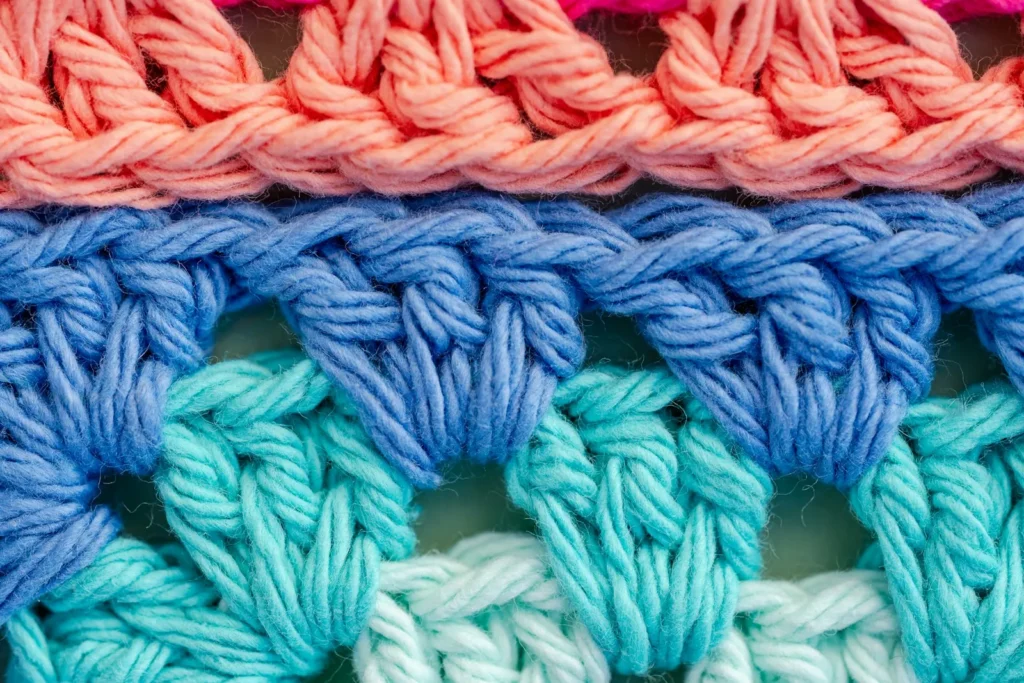
Single crochet is the first true stitch most crocheters learn. It is short, dense and sturdy, and it appears in everything from dishcloths to toys. This tutorial shows you how to work single crochet into a foundation chain, how to turn and work the rows that follow, and how to keep your edges straight.
This tutorial uses US crochet terms. In UK terms the same stitch is called double crochet (dc). If a UK pattern says “dc”, it means the stitch taught here.
At a glance
- Skill level: Beginner. You should already be able to make a slip knot and a chain
- Terms: US crochet terms. US single crochet (sc) = UK double crochet (dc)
- Yarn: Medium weight (category 4), smooth and light in color
- Hook: The size on your yarn label, often around 5 mm to 5.5 mm (US H-8 or I-9)
- Turning chain: 1 chain, which does not count as a stitch
- Time: Not timed. The practice swatch is small enough for one sitting
- Gauge: Not needed for practice. See the note on measuring your own gauge below
In this tutorial
About this guide: it explains standard technique. The photo at the top is a licensed stock image, not a photograph of a LoomMakers sample, and the diagrams are illustrations drawn for this article.
What you will learn
- How to make a single crochet stitch, one movement at a time
- Which chain to start in and why you skip the first one
- How to turn your work and where to place the first and last stitch of every row
- How to count stitches so your edges stay straight
- How to fasten off and weave in the ends
If you have not made a foundation chain before, start with how to crochet for beginners and come back.
Materials and tools
- Yarn: smooth, medium weight (category 4) yarn in a light, solid color.
- Hook: the size recommended on the yarn label, often around 5 mm to 5.5 mm (US H-8 or I-9).
- Scissors.
- Yarn needle (a blunt needle with a large eye) for weaving in ends.
- Stitch marker (optional but helpful) to mark the first stitch of each row. A scrap of contrasting yarn works too.
Abbreviations
| Abbreviation | US term | UK equivalent |
|---|---|---|
| ch | chain | chain |
| sc | single crochet | double crochet (dc) |
| st(s) | stitch(es) | stitch(es) |
| yo | yarn over | yarn over hook (yoh) |
| sk | skip | miss |
Where to insert your hook
Look at the top of any crochet stitch and you will see a sideways V made of two strands. The strand nearer to you is the front loop and the strand farther from you is the back loop.
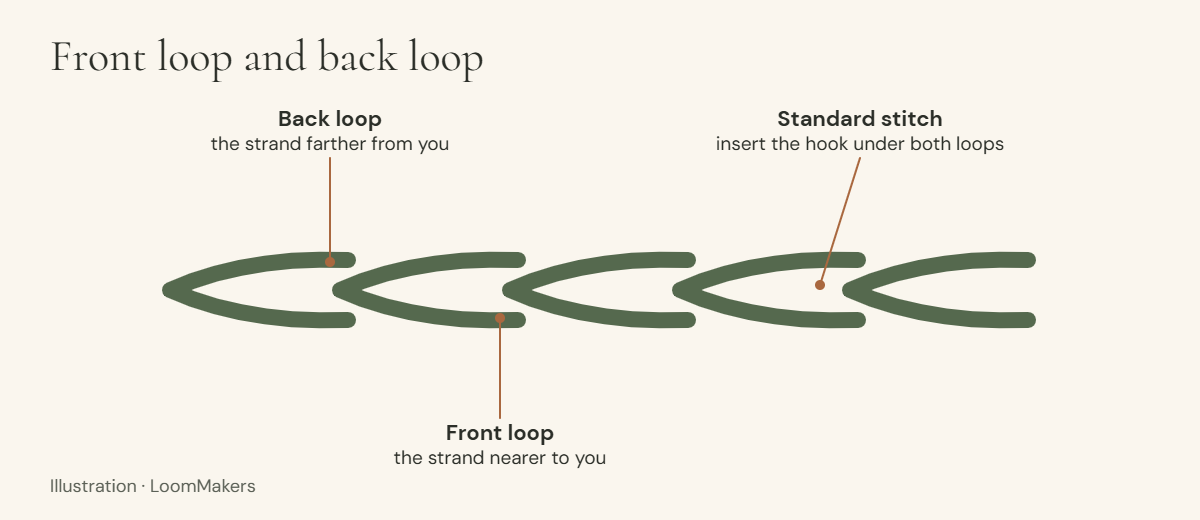
Unless a pattern tells you otherwise, insert the hook under both loops. Working under only one loop changes the texture of the fabric and is used on purpose in some patterns, where it is written as “front loop only” or “back loop only”.
Row 1: single crochet into the chain
Make a foundation chain of 16. You will work into 15 of those chains.
- Skip the first chain from the hook. Find the second chain from your hook. The loop on the hook does not count.
- Insert the hook into that second chain.
- Yarn over and pull up a loop. You now have 2 loops on the hook.
- Yarn over again and pull through both loops. One loop remains on the hook. That is one single crochet.
- Insert the hook into the next chain and repeat steps 3 and 4.
- Continue to the end of the chain, making one single crochet in each chain. Count your stitches: you should have 15.
Why skip the first chain? That skipped chain gives the hook room to rise to the height of the stitch. If you work into it, the edge of the fabric pulls tight.
Where exactly in the chain? You can insert the hook under the top strand of each chain, under the top two strands, or into the bump on the back of the chain. All three are used. Pick one and use it for the whole row so the edge looks even.
Row 2 onward: turn and work back
- Chain 1. This is the turning chain. For single crochet it does not count as a stitch.
- Turn your work so the other side faces you and the hook is again at the right-hand edge (the left-hand edge if you are left-handed). Turn the same direction every time.
- Single crochet in the very first stitch, the one at the base of the turning chain. Insert the hook under both loops of the V. Placing a stitch marker in this stitch makes it easy to find when you come back.
- Single crochet in each stitch across.
- Work the last stitch. It sits at the very edge and is easy to miss. Do not work into the turning chain from the row below.
- Count: you should still have 15 stitches.
Repeat these steps for every row. Counting at the end of each row feels slow at first, but it is the fastest way to catch a mistake while it is still one row deep.
Practice swatch pattern
Untested pattern. This swatch is a standard practice exercise written out in pattern form. LoomMakers has not yet made and measured a sample, so no finished size or gauge is given. The stitch counts follow directly from the instructions: 16 chains, less the 1 skipped chain, gives 15 stitches.
Foundation: Ch 16.
Row 1: Sc in 2nd ch from hook and in each ch across. (15 sc)
Rows 2 to 15: Ch 1, turn. Sc in each st across. (15 sc)
Fasten off and weave in the ends.
In plain words: chain 16, work 15 single crochet across, then chain 1, turn and work 15 single crochet in every row until you have 15 rows.
Measuring gauge and size
Gauge is the number of stitches and rows that fit in a set measurement, usually 4 inches (10 cm). It depends on your yarn, your hook and your own tension, which is why two people following the same pattern can end up with different sizes.
For a practice swatch, gauge does not matter. It is still worth measuring yours so you know how to do it:
- Lay the finished swatch flat without stretching it.
- Place a ruler across a row and count how many stitches fit in a set width, such as 2 inches, then scale up to 4 inches.
- Turn the ruler and count rows over the same distance.
When a pattern gives a gauge and yours has more stitches than it lists, your stitches are smaller, so try a larger hook. If you have fewer stitches, try a smaller hook.
Finishing
- Fasten off: after the last stitch, cut the yarn and leave a tail of about 6 inches (15 cm). Yarn over with the tail and pull it all the way through the loop on the hook, then pull snug.
- Weave in the ends: thread a tail onto the yarn needle. Run it through the back of several stitches in one direction, then back through a few in the other direction. Trim close to the fabric.
- Repeat with the starting tail.
Tips and troubleshooting
- Edges slanting inward (rows getting shorter): you are missing the last stitch of the row. Count, and look for the final V right at the edge.
- Edges growing outward (rows getting longer): you are working into the turning chain, or putting two stitches in one. Count each row.
- Fabric stiff and hard to work into: your tension is tight. Let each loop slide onto the full shaft of the hook, or go up one hook size.
- Fabric loose and gappy: go down one hook size.
- Not sure which stitch is first: use a stitch marker in the first stitch of each row and move it up as you go.
Common mistakes
- Starting in the first chain from the hook instead of the second.
- Counting the turning chain as a stitch. For single crochet, it is not one.
- Inserting the hook under only one loop without meaning to, which leaves a visible ridge.
- Skipping the count at the end of each row.
FAQ
Is single crochet the same as double crochet?
It depends on the terms used. US single crochet is the same stitch as UK double crochet. US double crochet is a different, taller stitch. Check which terms a pattern uses before you start.
Why are the sides of my single crochet not straight?
Almost always because the stitch count changed. Count 15 stitches at the end of every row, and make sure you work the first stitch at the base of the turning chain and the last stitch at the very edge.
How many chains do I need for single crochet?
The number of stitches you want, plus 1. For 15 stitches, chain 16.
Does the turning chain count as a stitch in single crochet?
In most patterns, no. With taller stitches the turning chain often does count, and the pattern should say so in its notes.
Related tutorials
- How to crochet for beginners: hook hold, slip knot and foundation chain.
- How to read a crochet pattern: understand lines such as “sc in each st across (15 sc)”.
- More crochet stitches and techniques.
Single crochet is worth practising until the movement is automatic: insert, yarn over, pull up, yarn over, pull through two. Once your swatch has straight edges and the same count in every row, you are ready to follow simple patterns.